
At times of war, with central government authority under pressure, countries often fragment along ethnic lines. These divisions are usually apparent beforehand, expressed in divergent political and other social practices, political violence and low-intensity insurgencies during times of relative peace.
I saw this happen on the ground in Syria during the Arab Spring, and over years analysing wars in Afghanistan and the Middle East noticed that the patterns of violence often fit cleanly onto countries’ ethnic maps. Ideologically-driven nation building efforts in various recent wars has seemed entirely at odds with human nature to use ethnicity as a stable basis for political organisation. Fighting to keep Afghanistan together under de facto Pashtun rule instead of handing the Uzbek areas to Uzbekistan and so on made little sense.
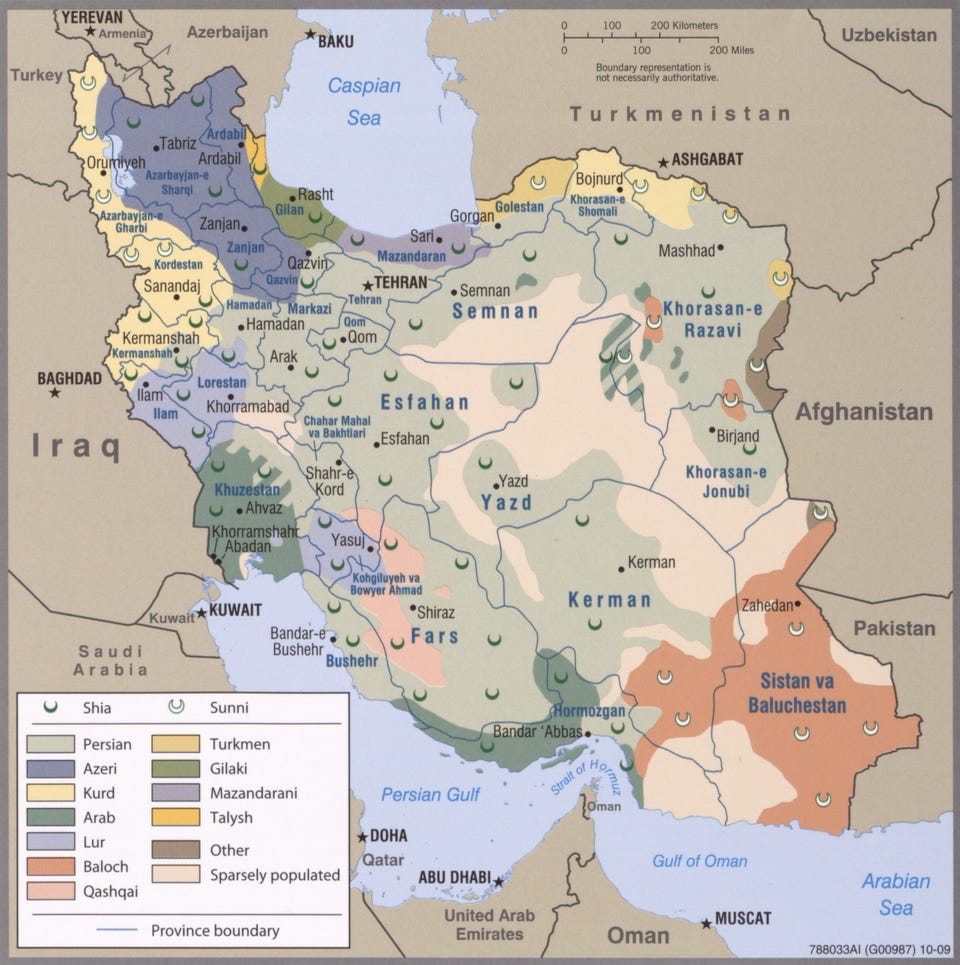
An ethnic map of Iran (CIA, 2009)
It is tempting, therefore, to pull out the map of Iran and advocate carving it up to quickly prevent a lengthy civil war. Knowing that wars tend to descend into ethnic bloodbaths, perhaps Azerbaijan should immediately stabilise the Azeri parts of Iran, Iraq take Arab Khuzestan, Iraqi Kurdistan take Iranian Kurdistan, Turkmenistan take the Turkmen areas and so on. And for the remaining areas, straight to a Bosnian Dayton Agreement-style quick peace. In Iran, broadly applying this approach is not likely to work in the way traditional ethnic maps suggest.
Genetic Proximity Mines
Analysing Iran from a Kinship Realist perspective allows us to view politics and warfare through the lens of evolutionary biology. Rather than using more qualitative traditional ethnographic approaches to military intelligence, it incorporates quantitative genetic data to model the behaviours of individuals and groups. The most important point is that, all else equal, the genetically closer the group, the more likely they are to be allies than adversaries in a conflict. This of course does not hold in all cases due to kinship entanglement, when the interests of genetically distant groups become entwined, but overall it is a good place to start from.
Traditional ethnic maps are not good enough. They give us no sense of how distant the various groups are from each other, just that they are distinct. The below heatmap on the left instead shows us how distant cosmopolitan Tehranis are from Iranian Azeris, Kurds and ethnic Persians. And on the right, the genetic distances from Turkish Kurmanji Kurds across the border.
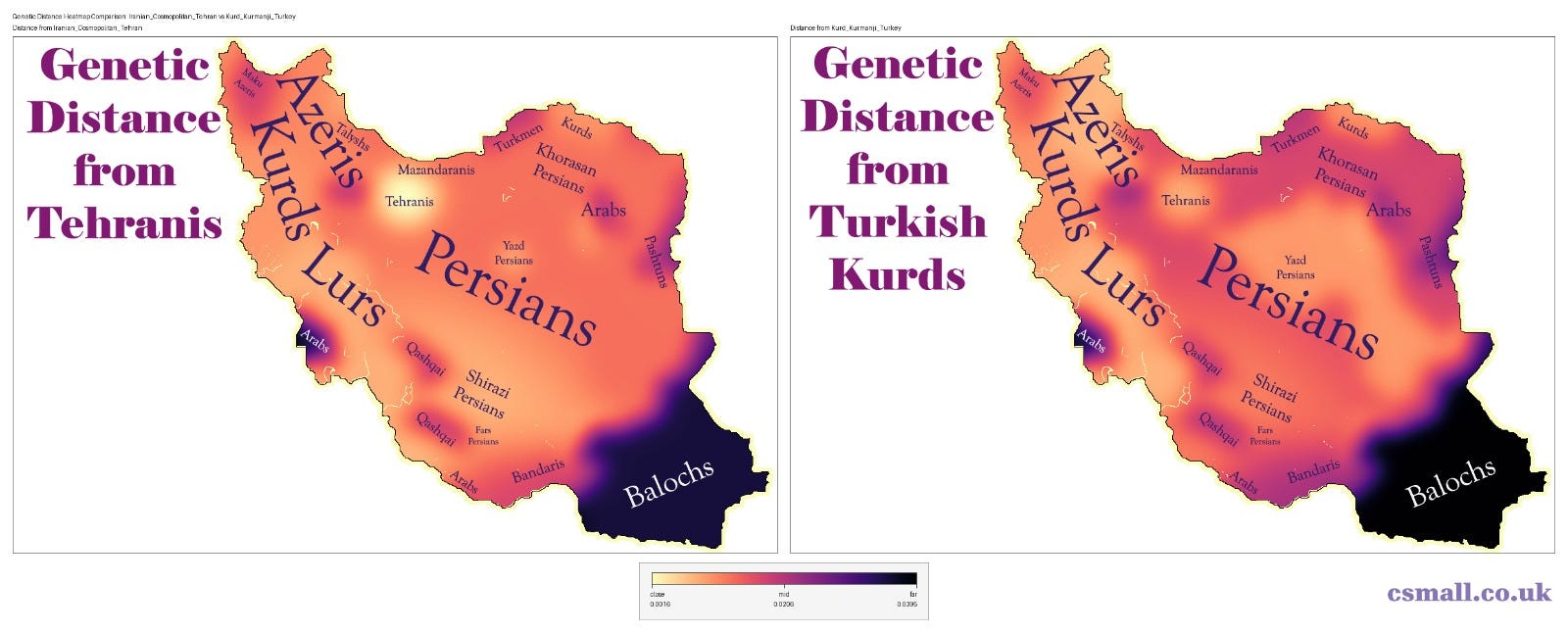
As you can see, Turkish Kurds are considerably more related to various Iranian groups than Iranian Arabs and Balochs are. In practice, this means that the groups have more recent common ancestors and are likely to be more intermarried.
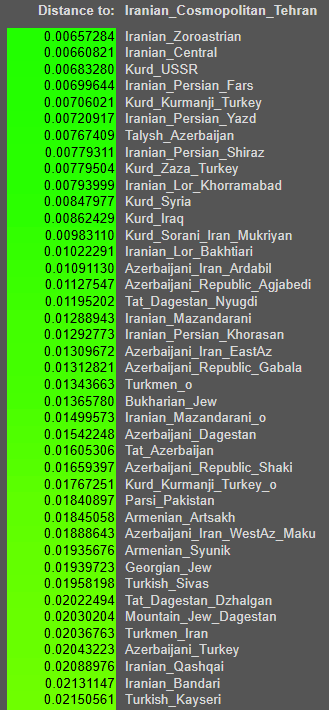
Genetic distance from Tehranis
The above table of genetic distances shows just how close to Persians the various Kurdish and other groups are. It shows that cosmopolitan Tehranis and Turkish Kurds are about as closely related as the English and Irish, and that Tehranis are about as related to Iranian Azeris as the English are to Belgians. This may surprise those using a linguistic categorisation method, but the Azeris only fully switched from their Iranic language to a Turkic one around the 17th C. Overall, Azeris, Kurds, Lurs and Persians are about as closely related as Northwest Europeans are. Of course, those familiar with military history will know that even the genetically close English and Irish are far enough apart to fight each other.
Applying this genetic analytical layer over standard military intelligence analyses helps us understand how using the Kurds against Iran could potentially backfire. Just as arming the very distantly related Balochs would endanger Pakistan, itself facing a Baloch separatist movement, arming Iranian Kurds risks the conflict spilling over into Turkey. When applying this approach to specific military leaders, we see that even the head of Iran’s IRGC as a Shirazi Persian appears to be more closely related to Turkish Kurds than to the Balochs living only a few hours’ drive from Shiraz. With this degree of proximity, one should expect the type of shared cultural practices and interfamily links through intermarriage that facilitate armed resistance.
Subscribe and get in touch to commission bespoke research.