
You’re a UK civil servant in charge of a new team running housing and immigration policy, and you need to house 400 people. 200 are from the Middle East and 200 are White British.
You look for somewhere suitable and find two towns. Each have 10,000 White British people living in the town centre and a surrounding suburb. Despite the low national birth rate, the towns’ populations are remarkably stable, almost as if natural decline, overcrowding and several other things have been controlled for in a statistical analysis using censuses from 1991 to 2021 and other government datasets. You see that both towns have capacity for 200 more people each. Perfect!
You accidentally sort your spreadsheet by ethnicity and then begin the allocation. In Town A, you put 200 Middle Easterners into the town centre. In Town B, you instead house 200 White British people. As is customary in the civil service, you then take a decade of time off in lieu of your hard work and check back on the towns later. What do you see?
Looking at your handiwork, you see remarkable differences between the two towns. Your diversified Town A now has a total population of 10,107 people, being 9,907 White British people plus the 200 Middle Easterners you placed in it. Town B, however, has a population of 10,200 White British people. Why is Town B now larger than Town A? They both had the same capacity.
According to Kinship Realism, biology explains much of this. Humans, like other organisms, exhibit kin preferences and all else equal prefer to live around people who are more like them. I don’t just mean in customs and habits, though that is of course true. I mean genetically closer to one another. To test whether this applies in England and Wales, I assigned the hundreds of recorded census ethnicities genetic coordinates using the Eurogenes G25 dataset, and measured their distance from White British reference populations. I then measured the relationship between growth of those populations and the local White British populations in the local middle layer super output area (MSOA) neighbourhoods in the censuses. As would be expected in a Kinship Realist model, local growth of genetically distant populations from the native White British was associated with lower White British populations at the end of the decade. To simplify the analysis, I then grouped the non-White British ethnicities and looked at urban areas outside of London.
White Flight Simulator: Feed the Churn
Urban Ex-London White Flight Simulator (+1 of ethnic group per 1,000 population)
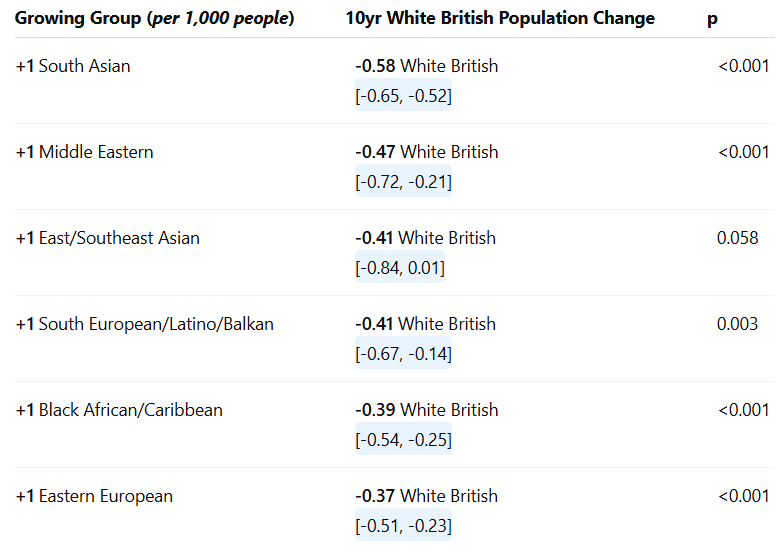
The negative values are the expected reduction in the White British population when each group grows by +1 resident per 1,000 starting residents, after controls over a decade.
To build the White Flight Simulator, I analysed UK census data from 1991, 2001, 2011 and 2021, joined with various official ONS and other government datasets to add controls. This allows us to hold our model towns constant by housing growth, flats, household composition, overcrowding, tenure, and population age structure, deprivation, student presence, starting population, starting White British share and region, while also accounting for growth by other ethnicities grouped by their ancestral home region. The 1991-2001 decade gives us useful context, but the best evidence comes from 2001–2011 and 2011–2021 with their consistent White British categories and geographical granularity.
This created a stock-change model, which means that we can look at what tends to happen in the thousands of MSOAs across England and Wales. We expect a normal amount of churn as people move in and out of neighbourhoods for various reasons. We’re measuring the expected change to that population churn, which includes things like people choosing not to move into the area, not renewing tenancies and so on. We can also account for capacity in an MSOA expanding as new houses are built or rooms converted, so we can feed more people into the neighbourhood’s churn and see what will likely happen over a decade. As we can see in the table above, when we feed non-White British people into the population churn and even when we hold many things constant, the local White British population declines. In reality of course, those things are not held constant and the population declines more rapidly than our model shows.
But you are a civil servant, and you’re worried you’d get fired for mentioning the White Flight Simulator at work, so you keep on moving people into towns and the native populations keep shrinking. Still, you now know that you are contributing to native population displacement while you’re doing it. Anyway, is that the time? Don’t worry, you’ll be able to claim all this back as time off in lieu and go on a nice holiday! Would you like to go to Town A or Town B?
Subscribe and get in touch to commission bespoke research.
When you think about it, it is incredibly fascinating that our civil servants have not done more to hinder non-European migration. In Sweden, we have basically lost Malmö to non-European migration, and Gothenburg and Stockholm are on this trajectory, too. It is in the cities that our political and administrative power is concentrated. What a catastrophe.
In these major cities, there are now political projects (by left-wing political majorities) to force the natives to integrate with the new arrivals, by building cheap social housing for migrants in the middle of middle-class areas. I guess this will just accelerate this process and eventually it will develop into a rural-urban conflict.