
The economist Danny Quah famously invented the concept of the world’s economic centre of gravity, a point on the map that shifted eastwards with China’s rise to economic prominence. I’d like to introduce the concept of genetic centres of gravity.
Everyone has genetic coordinates, whether they like it or not. These tend to be clustered into ethnic groups, and are then averaged out to give that group’s coordinates, which can be plotted with others in a pretty 3D chart. These coordinates are typically plotted in 2D or 3D due to our human brains not being able to comprehend the standard format, simplified into a mere 25 dimensions.
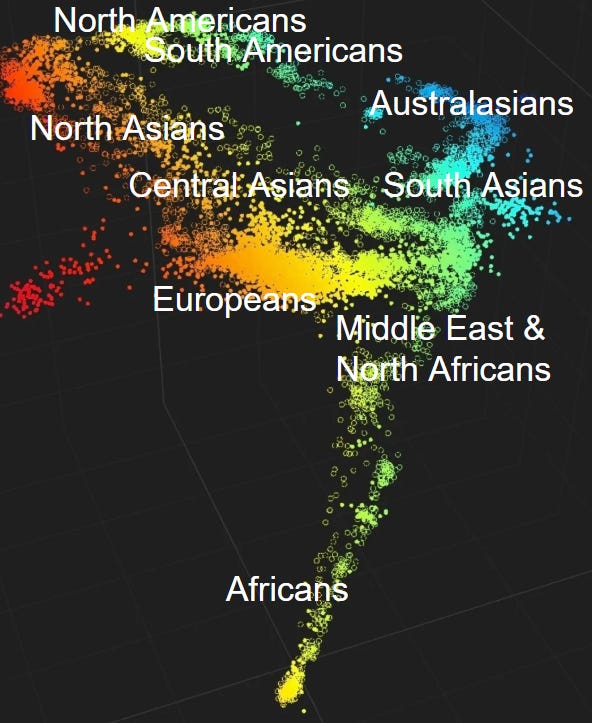
The genetic modern world in three dimensions (Eurogenes Global 25 in Vahaduo)
This 3D visualisation is remarkable by the way in which it reflects the geography of our world in a sort of lasso shape. Imagine a traveller starting a journey at the bottom tip of Africa. At the base of the lasso in yellow are the native African ethnicities the traveller encounters, which in this model cluster together at the bottom. In reality, Africa’s Khoisan and Mbuti ethnic groups are the furthest away from each other in genetic distance, but here they are clustered. In his journey in Africa, he meets groups with so-called “ghost DNA”, admixture of up to a grandparent’s worth of DNA from other hominids who others outside of Africa do not appear to have met.
As the traveller journeys up the lasso towards North Africa, he begins to encounter Arabised Africans, and towards the top of the straight part of the lasso are the Middle Eastern ethnic groups, merging into Europeans. Here, he meets people partially descended from the Neanderthals. He had seen very slight traces of their presence in Africa, but not to this extent.
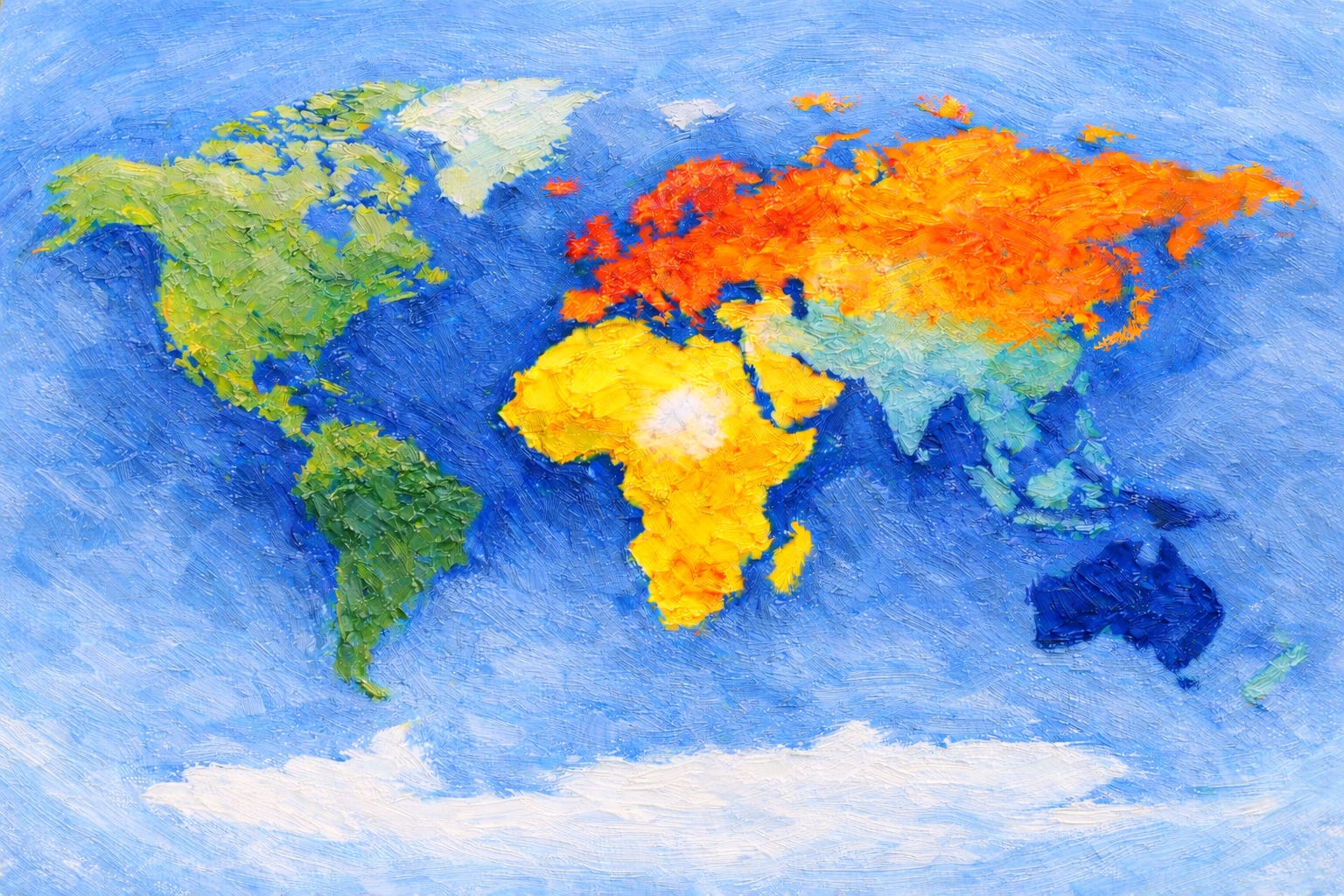
A very rough approximation of genetic groups, colour divergence not to scale
Standing in the Middle East, our traveller faces the option of going left (West) to meet the red dots, the ancient Western Hunter Gatherers who modern Europeans are partly descended from. Or he may turn right (East) towards the blue dots and encounter those from the Indian subcontinent. As he explores the ring of the lasso, he notices a large impassable area between the blue and orange dots, the great genetic hole in the middle caused by Asia’s ethnic groups being long separated by the Himalayas.
In the bluest part of the lasso, he meets Papuans and others, and finds that they’re admixed with a previous group of travellers named the Denisovans, leaving sometimes double-digit percentage traces in local genomes. He considers whether the red dots of the European hunter-gatherers may themselves have been admixed with hominids as yet undiscovered, rather than drifting away alone.
Now, he sees that the far end of his lasso is split again into Northeast Asians and Native Americans. In Northeast Asia, he is a very long way from the tip of Africa now. Here, he sees traces of both Denisovan and Neanderthal admixture. Are these the descendants of Dragon Man? He sees the journey Native Americans must have taken, over Alaska’s Bering Strait, and across the Pacific from Polynesia to settle these vast continents. Looking back at his journeys, he sees the paths many have taken before, shaped by geography.
No Escaping Gravity
Ethnic groups’ proximities to each other in the genetic coordinate space we have just explored likely matter in real life due to organisms’ predisposition to kin preference. Genetic similarity theory explains that more similar organisms tend to cooperate more, something I’ve extrapolated in the political sphere to Kinship Realism.
As the UK’s population rapidly changes due to mass migration and differential fertility rates of the White British and postwar immigrant populations, we see changes in the genetic coordinates of the “average British person” too. Before WW2, the average Brit had coordinates effectively an average of just the English, Irish, Scottish and Welsh ethnic groups, with negligible contributions from other populations.
To look at how this is changing in modern Britain, let’s use Eurogenes G25 coordinates and simplify things by only looking at England in the census years 2001, 2011 and 2021, treating all White British people in England including the Cornish as just English.
For the avoidance of confusion, I’m going to use the term “Englander” to describe someone from or in the country England regardless of ethnicity, and “English” to refer to someone in the English ethnic group, generally being Anglo-Saxons admixed with Brittonic peoples. I also take census numbers at face value, despite them likely underestimating the immigrant population.
Over this 20-year period, our average Englander changed significantly. In 2001, soon after Blair and Brown’s Scottish Raj ramped up immigration, he was already more genetically distant from an Englishman as a Welshman is. By 2011, he was as distant as a Scandinavian, and by 2021 as far away as a Belgian.
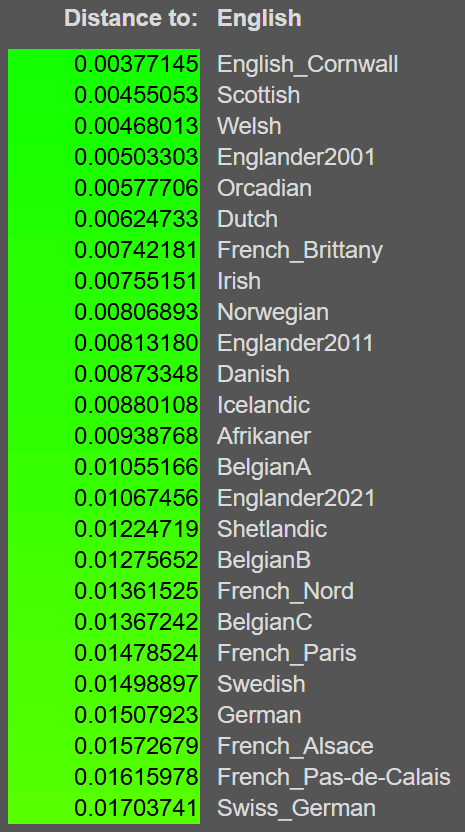
Our average Englander is rapidly distancing himself from the ethnic English
2021: A Race Odyssey
By 2021, the composition of the United Kingdom had changed considerably from its prewar demographic situation. Following the political crisis created by the unexpected arrival of people aboard HMT Empire Windrush, the government ramped up mass immigration over the decades, often responding to political crises abroad under a general ideological framework heavily influenced by American culture and political warfare operations. This preference for mass immigration has meant the weighted average coordinates have shifted significantly.
Likewise, in the American imperial metropole, the coordinates have shifted away from European genetic clusters. The metropole appears to be dragging its European holdings away from their starting points through its cultural transformation policies. These shifts are heading in slightly different directions. Our average Englander is moving gradually closer to both the African and South Asian clusters. Our average American in contrast started more towards the African cluster, and has moved towards the more distant Native American clusters due to influx of Latin American immigrants.
This is of course a reductive average. In reality, the numbers obscure the increasing variability of real Americans and Englanders. When applying a Kinship Realist perspective to a shared security issue of the UK's unnecessary gifting of the Chagos Islands and large amounts of cash to the shadow banking hub Mauritius at the expense of the USA's security, we see that the architect of the UK civil service's policy was a Delhi-born Indian, significantly genetically closer to the ethnically Indian leaders of Mauritius and the Indians on the military base there than an Englishman is. One would expect that, all else equal, someone beyond the threshold of foreignness to the English would behave differently to an Englishman, who is genetically close to American leaders with predominant ancestry from the British Isles.
Despite genetic centres of gravity obscuring such nuance, the tool's simplicity allows for relative ease of comparison. Should the United States over time become de facto Greater Mexico due to its Latin American immigration, all else equal one would expect it to diverge in approach to the UK as its centre of gravity further diverges. As the average Englander becomes less English, one would also expect a divergence in the UK's policy preferences. Perhaps more importantly, one would not expect the UK to give as great a priority to the needs of its English population.
Subscribe and get in touch for more detailed analyses.